
Sustainability starts in the classroom


The Global Society Institute (GSI) has held two educational workshops at CEIP Virgen del Sol in Tarifa, supporting primary school pupils in examining how their school can become a more sustainable place.
The workshops were designed and facilitated by Sabrina Förster and Manuela Thiele, who contribute to GSI’s work in Intercultural Dialogue and Education. This field of the Institute supports non-formal education, intercultural learning, knowledge-sharing between civil society and educational environments, and the inclusion of the Sustainable Development Goals (SDGs) in meaningful learning processes.
The sessions involved two pupil groups: 25 third-grade students and 25 fourth-grade students. Each workshop lasted around 70 to 90 minutes and was structured as an interactive learning activity, encouraging children to take part actively, ask questions, and relate global sustainability topics to their everyday experiences at school, at home, and in the wider community.
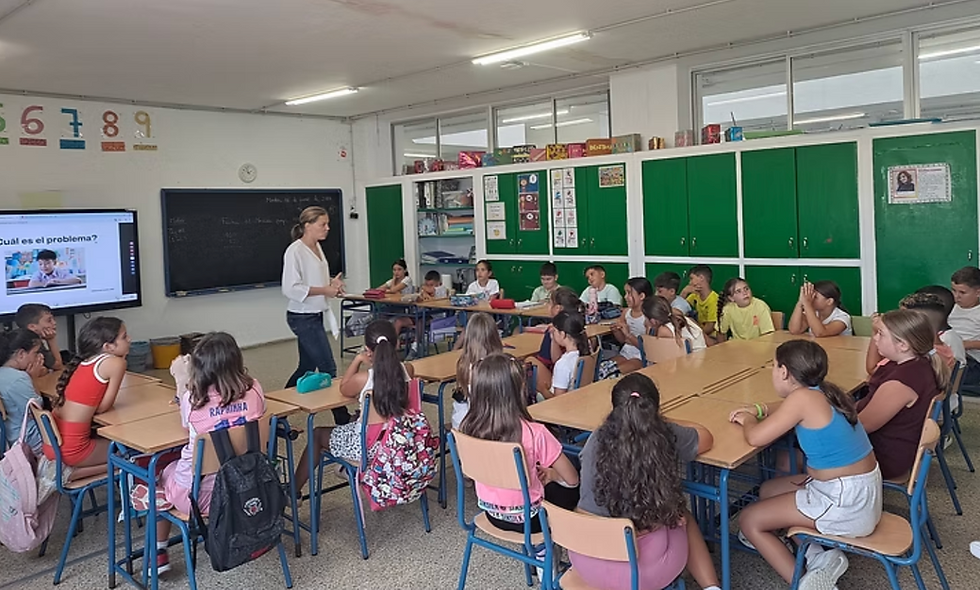
The workshops opened with an introduction to the Global Society Institute and the Sustainable Development Goals. The SDGs were explained to the pupils as common goals aimed at building a better world for all. From there, the sessions linked sustainability to the school setting, daily habits, and the contribution each individual can make within their community.
A key element of the programme centred on the idea that “the world is changing”. Pupils considered several major environmental challenges of today, such as plastic pollution, the effects of waste on marine life and birds, air pollution, wildfires, and flooding. The purpose was not only to explain environmental issues, but also to increase awareness and help pupils recognise that global challenges can be connected to places close to them.
The educational material also presented basic concepts related to climate change, including the carbon cycle, the greenhouse effect, and the water cycle. These topics were introduced in a visual and accessible manner, helping pupils understand the links between human activity, natural systems, and environmental change.
In addition to the environmental content, the workshops offered a simple introduction to project management. Pupils were guided through four basic stages: choosing a project and defining its objectives, planning how it could be carried out, putting the transformation into practice, and evaluating and reflecting on the outcomes. This method helped show sustainability not only as a concept, but as something that can be organised, implemented, and reviewed collectively.
The most participatory moment of the workshop took place when pupils worked in smaller groups to identify possible ways to make their school more sustainable. Ideas discussed included cycling to school, organising campaigns to raise awareness about waste, collecting rubbish, planting watermelons, promoting more sport and active lifestyles, supporting family members and older people, and encouraging respectful behaviour among classmates and friends.
These ideas demonstrated that, from the pupils’ point of view, sustainability goes beyond the environment. It also involves health, care for others, respect, cooperation, and shared responsibility. In this way, the workshops connected environmental education with the social values that influence everyday life within a school community.
The next stage will be for each class to choose at least one of the ideas discussed during the workshop and develop it as a project in the classroom or across the school, with teacher support. The Global Society Institute may also support this process, reinforcing the link between education, local action, and commitment to the Sustainable Development Goals.
The initiative reflects GSI’s approach to Intercultural Dialogue and Education: creating learning spaces that are practical, participatory, and connected to real-world contexts. At CEIP Virgen del Sol, this approach was shaped around a simple question for the pupils: what can you contribute to your school?
By bringing the SDGs into the classroom through an interactive format, Sabrina Förster and Manuela Thiele helped translate major global challenges into small, concrete, and achievable projects. The workshops demonstrate how sustainability education can begin with a classroom discussion and continue through real action within the school community.


